
Finding Oakland People From One Detail
The first move depends on whether the known fact is a name, an address, a business, or a past event. Alameda County's recorder index is built around names on recorded documents. Its assessor search works in the other direction, beginning with a parcel number or street address. Court records can connect a party name with a case, while a professional license or business filing can separate two people who share the same name.
Old Oakland addresses call for a different path. Reverse directories can identify an occupant by street or phone number, then deeds, obituaries, probate cases, and later directories can extend the timeline. A phone number alone is less useful in official records, but a city staff directory or historic criss-cross directory may still place it. Use spelling variants, initials, middle names, and date ranges before deciding that a person is absent.
- Write down the name, address, date, or organization already known, including alternate spellings.
- Use Alameda County recorded documents for a name, or the assessor portal for an address or parcel number.
- Check Alameda court party records when a civil or probate matter could connect the person to an event.
- Move older searches to Oakland city directories, reverse directories, death notices, and historical certificates.
- Contact the custodian by counter, phone, email, mail, or a records request when the online index does not cover the needed file.
Note: Search one source at a time and save its record number, date, and name spelling before moving to the next.
Oakland Records Desks Behind Searches
Oakland is the Alameda County seat, so several countywide records desks sit within the city. The Clerk-Recorder keeps deeds, liens, fictitious business names, and county birth, death, and marriage copy services. The Assessor connects parcels with assessment and ownership information. City records remain with Oakland departments, led by the City Clerk Records Management Division. These custodians are separate, even when one person's trail crosses all three.
The Oakland public records access overview carries the full request and copy rules. For a people search, the key is choosing the office that created or received the record rather than sending one broad request to every desk.
Alameda County Clerk-Recorder
1106 Madison Street
Oakland, CA 94607
510-272-6362
Alameda County Assessor
1221 Oak Street, Room 145
Oakland, CA 94612
Address and parcel service
Assessment and ownership records
Oakland City Records
1 Frank H. Ogawa Plaza
Oakland, CA 94612
510-238-3612
City Clerk Records Management Division
Oakland Deed Search Crosses 1969
Alameda County official public records begin in 1853, but the online electronic index begins in 1969. That line changes the method, not the existence of the record. For 1969 to the present, the recorder portal can find documents alphabetically by names of parties. A grantor is the person or entity transferring an interest, while a grantee receives it. Results may identify the document type, recording date, document number, and book or page reference.
Records before 1969 are on microfilm and must be searched by hand at the Oakland Clerk-Recorder counter. A visitor may come in person or send a representative or title company, complete a copy request form, and pay for copies. Plain official-record copies cost $3.50 per page. Certified copies cost $4.50 for the first page and $3.50 for each added page. Printing stops at 4:15 p.m.; requests placed after 4 p.m. move to the next day, and large copy orders can take one to three business days.
The Alameda County official-record instructions show that online and counter routes cover different years.
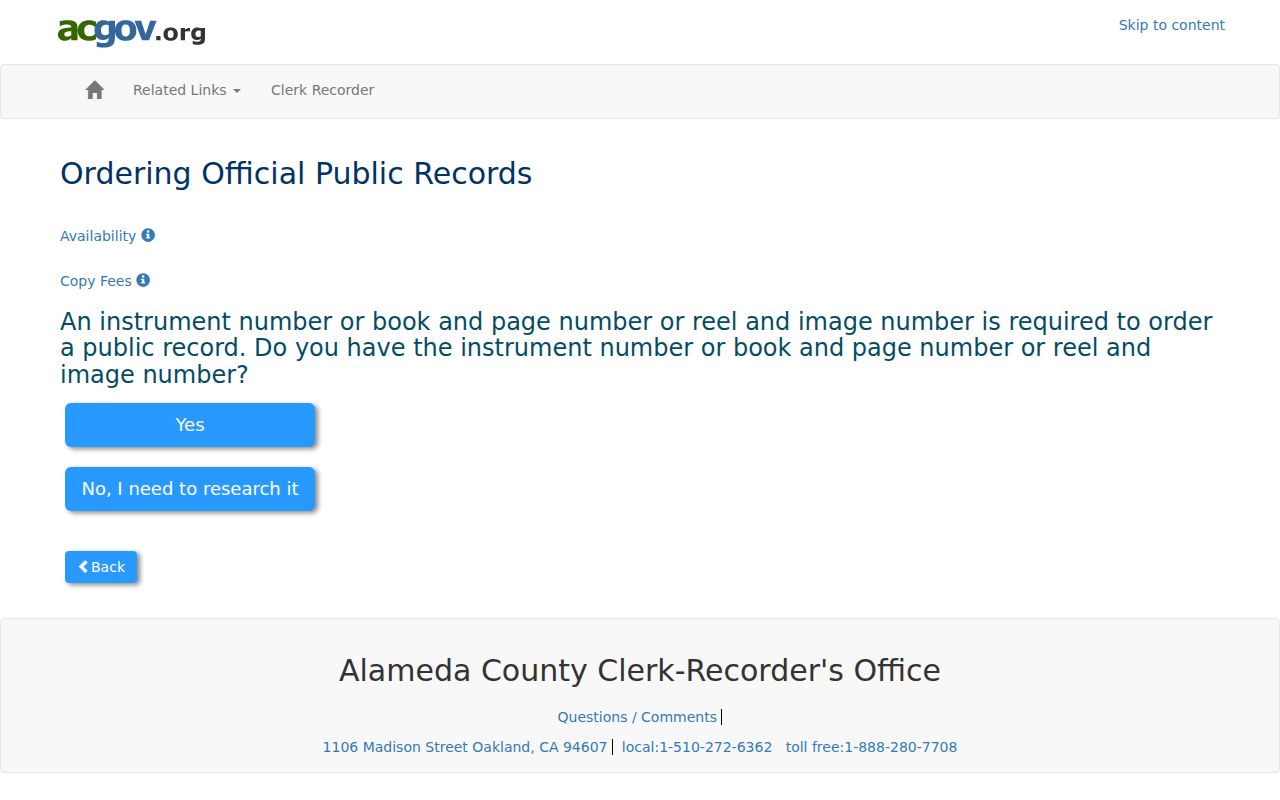
The captured instructions explain why a web search can miss an older Oakland deed even though the county still holds it.
- Index
- A list used to locate a record, not always the record image itself.
- Grantor
- The party that gives or transfers an interest in a recorded document.
- Grantee
- The party that receives the transferred interest.
- Certified copy
- A copy authenticated by the custodian for formal use.
Oakland Address Search Follows Geography
An Oakland street address may point to several related facts: the situs address where a parcel sits, the mailing address used for tax correspondence, the assessor parcel number, the legal description, and a neighborhood or older place name. Historical annexation adds another layer. A resident may appear under Oakland, Brooklyn, Alameda Township, or a nearby boundary description depending on the year and source.
The assessor's public screen searches Parcel Number, Type Ahead Address, or Property Address. It does not present a broad owner-name box on the opening screen. Parcel numbers must contain two or three dashes, following the form shown on a tax bill. The property hub then points to assessment details, ownership information, parcel maps, tax records, and the county's open-data tools. Map data is useful for context, but Alameda County warns that GIS data is dynamic and is not a legal survey.
| Search field | Best starting fact | Format note |
|---|---|---|
| Parcel Number | APN from a tax bill or deed | Enter with two or three dashes |
| Type Ahead Address | Known Oakland street | Select a suggested address |
| Property Address | Full situs address | Searches the physical parcel address |
The Alameda County property search displays these three starting modes.
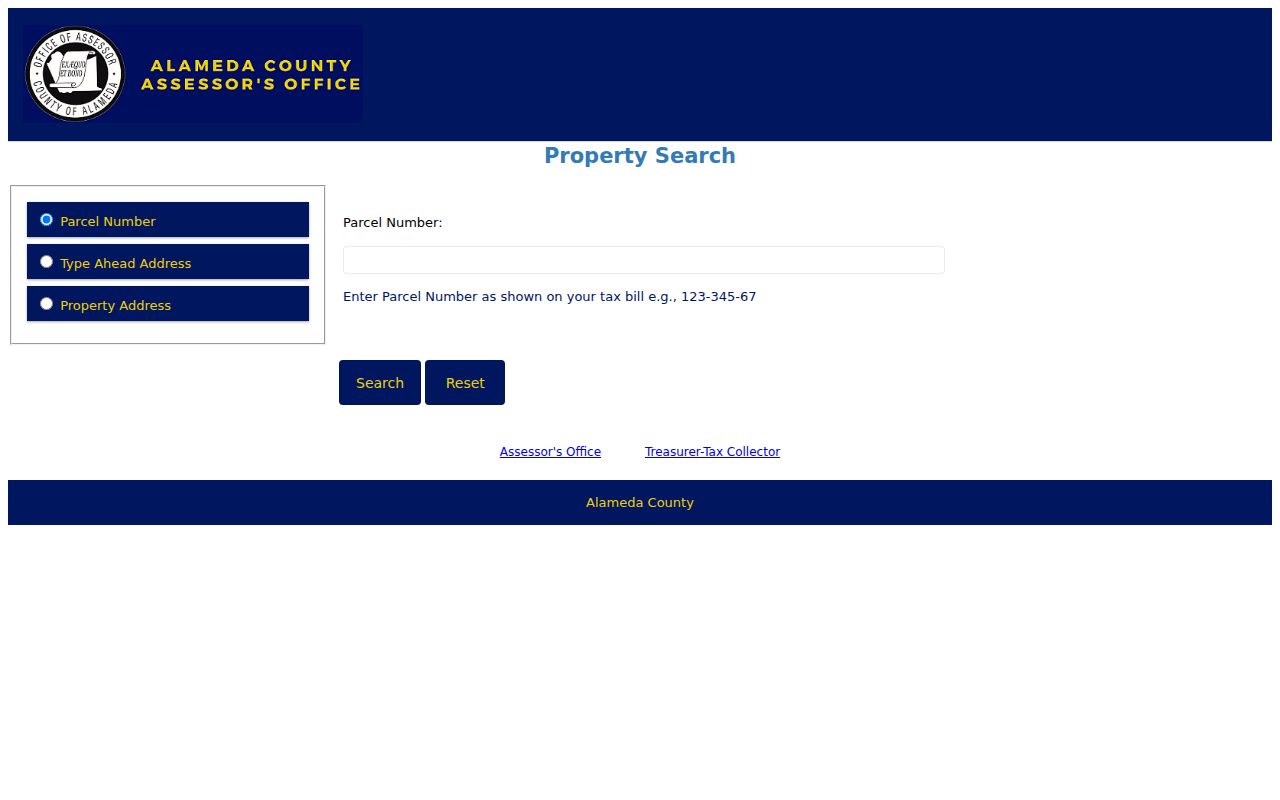
The screen confirms that Oakland address research begins with an APN or address, not a universal owner-name directory.
Oakland Court Name Search by Case
The Superior Court of California, County of Alameda splits access by case type. Alameda eCourt covers civil, family law, probate, mental health, adoption, and CARE matters. A user account is required for portal functions. Search results can lead to a case number, party role, filing date, assigned department, register of actions, and available document images. A docket is the dated list of events and filings in a case, not proof that each allegation is true.
Criminal, juvenile, and traffic records do not appear in eCourt. Non-confidential criminal case copies use the court's separate Criminal Records Request channel. Juvenile matters, sealed files, and protected details may be unavailable. Federal cases involving Oakland run through PACER for the U.S. District Court for the Northern District of California. Thus, no result in eCourt means only that no match appeared within that portal's covered case types and access rules.
| Record route | Coverage | How to reach it | Limit |
|---|---|---|---|
| Alameda eCourt | Civil, family, probate, mental health, adoption, CARE | Account-based party and case search | Images may carry a fee |
| Criminal request | Non-confidential criminal documents | Separate court request service | Not part of eCourt |
| PACER | Federal cases | Federal account system | Paid document access may apply |
The Alameda court public-portals page sets out the eCourt coverage and exclusions.
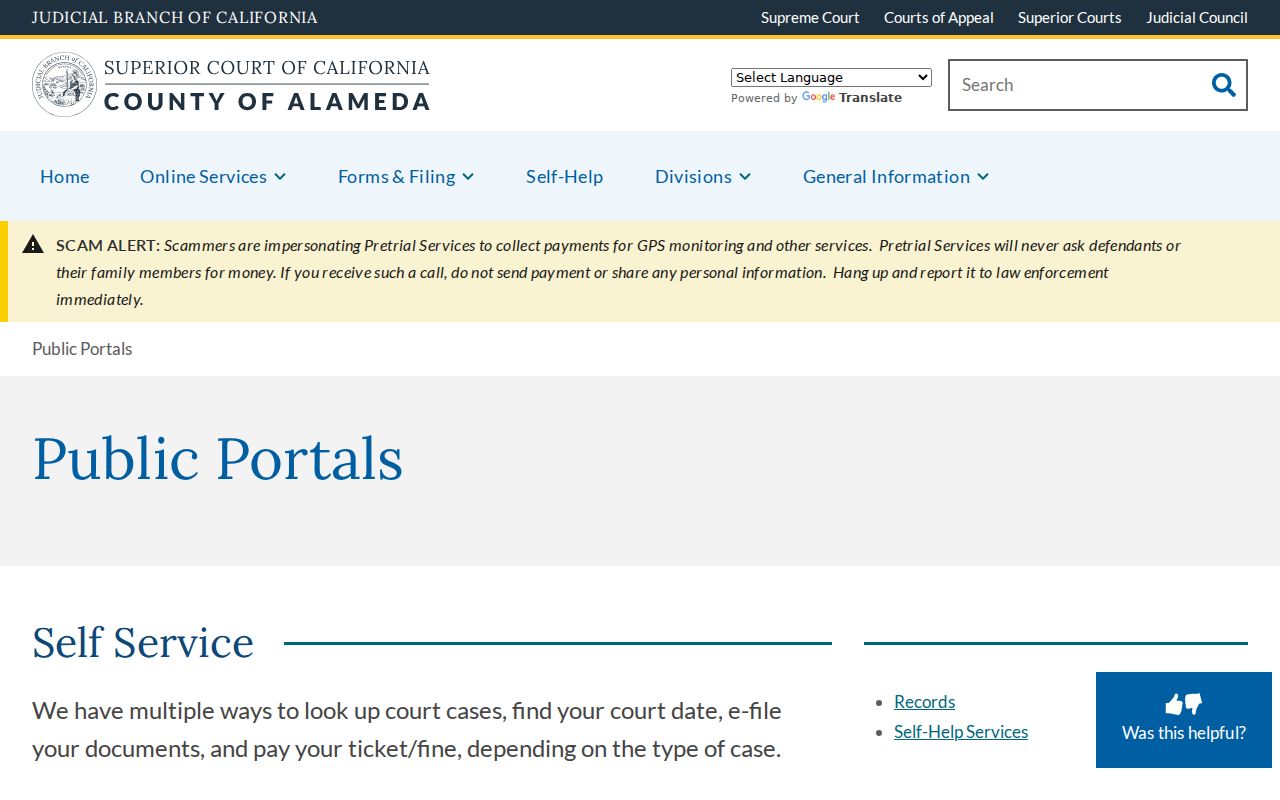
The court page makes the case-type split visible before a researcher treats one portal result as a complete court search.
Note: Probate records can aid an heir search, but sealed documents and private details remain subject to court access rules.
Oakland Vital Records Search Paths
Alameda County Clerk-Recorder issues certified copies for births, deaths, and marriages that occurred in the county. CDPH Vital Records provides the statewide path. California Health and Safety Code section 103526 divides copies by eligibility: an authorized certified copy requires an authorized requester and a sworn statement or identity check, while other requesters may receive an informational certified copy for a birth, death, or nonconfidential marriage when permitted. Confidential marriage records are limited to a party or a court-authorized route.
Divorce files follow a separate trail because the Superior Court holds the family-law case. The county vital-record order portal does not replace the court decree file. For older Oakland events, the library can check city birth and death certificates from 1870 through 1904, plus local death notices and obituaries. Those historical searches are reference work, not a substitute for a current certified copy.
Online ordering, the Oakland Clerk-Recorder counter, phone help at 510-272-6362 or 888-280-7708, and CDPH are the documented copy channels. Library history requests add phone, email, mail, and in-person research for the older sources.
Oakland Library Records Reconnect Families
The Oakland Public Library gives a people search a local depth that current portals cannot match. The Oakland History Center holds city directories from the late nineteenth century into the twentieth, reverse directories that work from an address or phone number, Alameda County censuses from 1870 through 1960, and voting registers from 1867 through 1944. It also points researchers to newspapers, archive finding aids, Calisphere, and the African American Museum and Library at Oakland.
Reference staff will perform up to two searches per month for Oakland city directories, Oakland birth or death certificates from 1870 through 1904, and death notices or obituaries. Phone and email requests normally receive a response within three business days. Mailed requests should allow one to three weeks. In-person work remains important for census and voting-register holdings. This service helps reconnect relatives and classmates or trace a family line when spelling, age, or an old street is the only firm fact.
Oakland directories were not printed in every year. Known gaps include 1919, 1920, 1929, 1931, 1932, 1936, 1942, 1944 through 1966, and 1968. A missing year is therefore a publication gap, not a failed name search.
Oakland Heir Search Builds a Chain
An heir or estate trail works best as a linked chain rather than one broad name query. Start with a decedent or estate name in Alameda probate records. Then use recorded deeds to see whether Oakland real property changed hands and compare the assessor mailing address with the property address. Library obituary and death-notice work may identify relatives, while city directories can place family members together in an earlier year.
The chain is simple: probate name to case number, case to estate parties, property address to parcel, parcel to deed, then obituary to relatives. Each step should agree with at least one other fact, such as a middle initial, street, spouse, or date. Adoption records and sealed court files are confidential, so family-history work must stay with sources that are lawfully open.
Oakland License and Business Searches
Business and license records help distinguish people with common names. The California Department of Consumer Affairs advanced search accepts first name, last name, license number, business name, and license type. A result can show the licensee or company, board, license number, status, expiration, and a discipline indicator. Alameda County fictitious business names cover the last nine years through the current filing, while the California Secretary of State business system covers state entity filings.
The California DCA advanced license search shows the name, business, and license filters used to narrow a result.
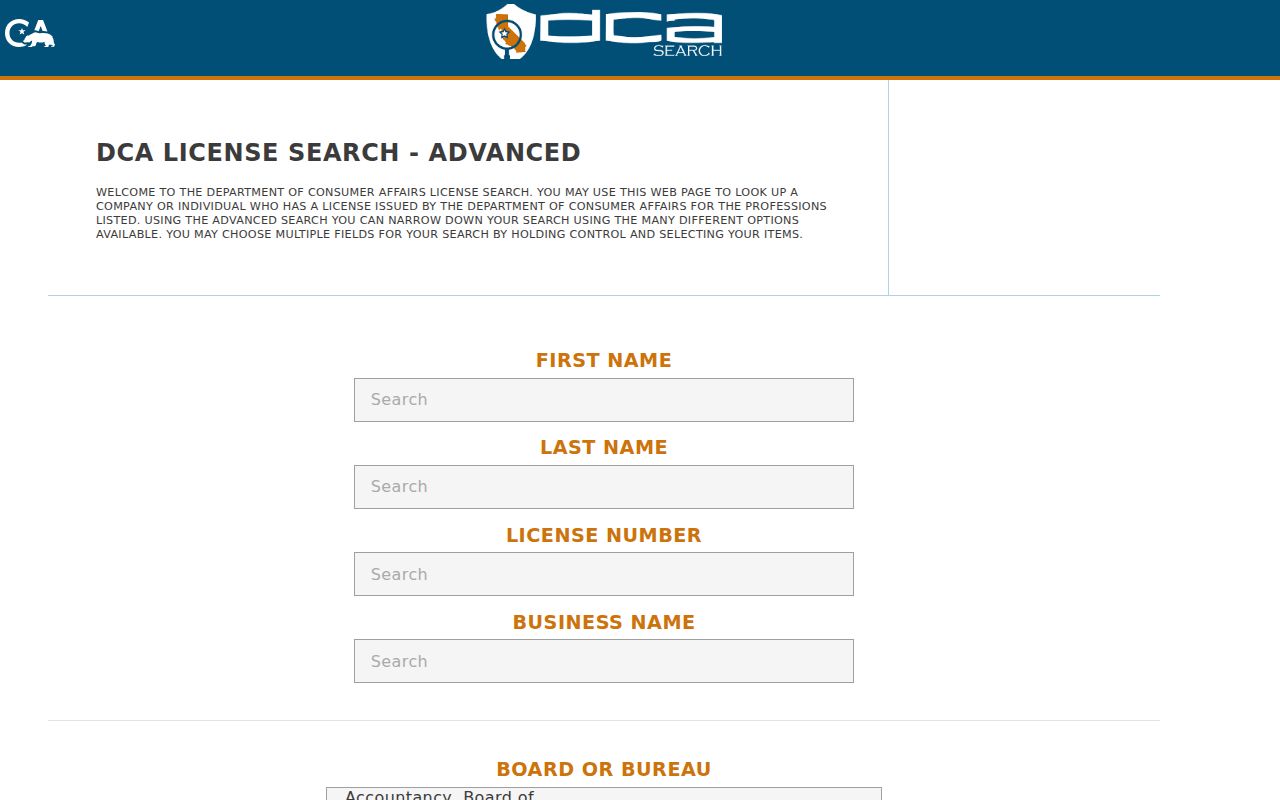
The captured fields make it possible to test a full name against a board or business rather than accept a loose name match.
The California business entity search supplies a second official route for entity names and filings.
Entity results may connect an Oakland business name with its state record, address, agent, status, and filing history when those fields are public.
Oakland Unclaimed Property Name Search
California's State Controller keeps a free unclaimed-property search for funds and assets turned over to the state. A name and city can uncover old checks, refunds, dormant accounts, insurance proceeds, and similar property. The result is a lead, not proof that every person with that name is the owner. Compare the listed location and reported owner details before beginning a claim.
This route is valuable when a person has left Oakland but an older city association remains in the state data. Search name variants and prior surnames. A claim should go through the official state process; an up-front fee from an unsolicited third party is not needed to search or claim state-held property.
The California unclaimed property search is the official name-and-location lookup.
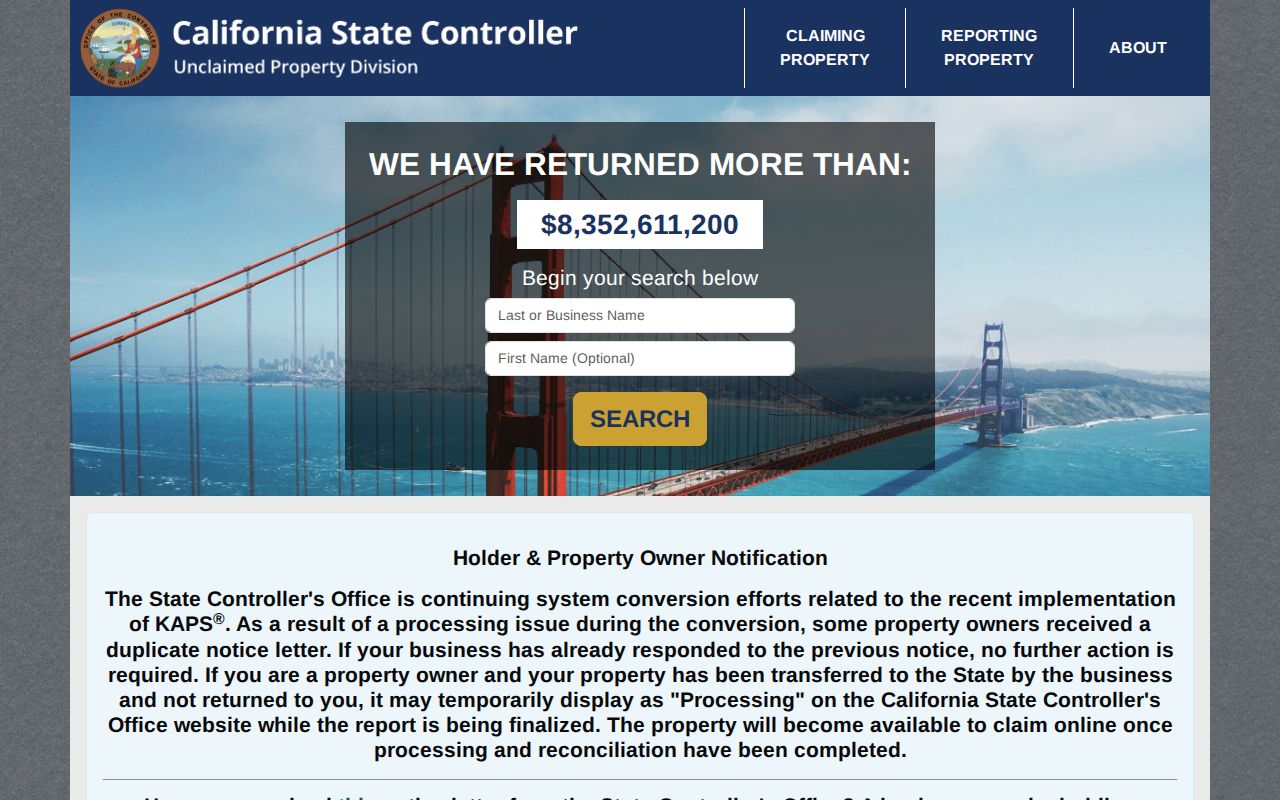
The state screen offers a focused way to test an Oakland place association without buying a compiled commercial report.
Oakland City Records Beyond Portals
Not every city record has a public name index. Oakland uses NextRequest for general city public-record requests, and the City Clerk Records Management Division also provides phone and email help. A requester can check an existing request in NextRequest or contact the department's records liaison. California's Public Records Act requires an agency to determine within 10 days whether it has disclosable records, with a possible 14-day extension in unusual circumstances. That is a determination period, not a promise that every file arrives within ten days.
Police records have online, email, phone, counter, and mail channels through the Oakland Police Records Division. Planning and Building files start in NextRequest; the requester should choose that department and wait for staff contact before moving to plan duplication. Records staff also accept email at RecordsInfo@oaklandca.gov and calls at 510-238-3606. Code-enforcement complaint status uses Accela Citizen Access after a complaint has been filed.
Ask for a described record, date range, address, or department rather than demanding every record about a person. A narrow request helps the custodian locate the actual file and apply required redactions.
Oakland Voter Records Have Boundaries
California My Voter Status is an identity-based personal lookup for a voter's own registration and election details. It is not a public search box for other Oakland residents. The statewide voter information file follows a separate application and is limited to election, scholarly, journalistic, political, or governmental purposes allowed by law. Confidential voter records and preregistration records for minors are excluded.
A lawful voter record may include name, releasable residence or mailing address, party preference, registration status and date, county, precinct, districts, and participation history. It never reveals ballot choices. Safe at Home and the confidential-voter statutes protect qualifying addresses. The Oakland voter records explanation separates self-lookup, regulated file access, and historical voting registers.
Oakland Official and Commercial Search Results
Official records and compiled commercial results serve different roles. A county index identifies the custodian, coverage, and record number. A court docket identifies a case event under court rules. A commercial result combines data from many sources, but it may merge two people, retain an old address, omit a correction, or charge for facts available from the keeper.
| Source type | Main strength | Main limit | Best check |
|---|---|---|---|
| Official index | Direct link to a custodian | May cover limited years or fields | Confirm the record number and date |
| Counter or archive | Older and offline material | May require time and copy fees | Ask about coverage before visiting |
| Compiled service | Broad initial lead | Can be stale or mismatched | Verify every fact at the official source |
Start with free official searches when possible. Pay for a copy only when the actual document is needed, and keep a record of where each fact came from.
Oakland Privacy and Fraud Records
Official access has firm privacy limits. Court records may hide sealed cases, juvenile matters, adoption files, victims, and other protected details. Voter data excludes protected addresses and confidential categories. Vital records use authorized and informational copy rules. Recorded documents should not display Social Security numbers or other sensitive identifiers. A missing field may reflect law and safety, not a weak search.
California's DROP program now lets residents send one deletion request to hundreds of registered data brokers. That process affects broker-held data, not the underlying official public record. Safe at Home supplies a substitute mailing address for eligible participants as part of a safety plan. These programs reduce exposure while preserving the separate legal rules governing open government records.
Alameda County also points property owners to fraud alerts and the District Attorney's real-estate fraud resources. The Alameda County property information hub gathers the official assessment, parcel, ownership, and tax routes used to verify a suspicious property claim.
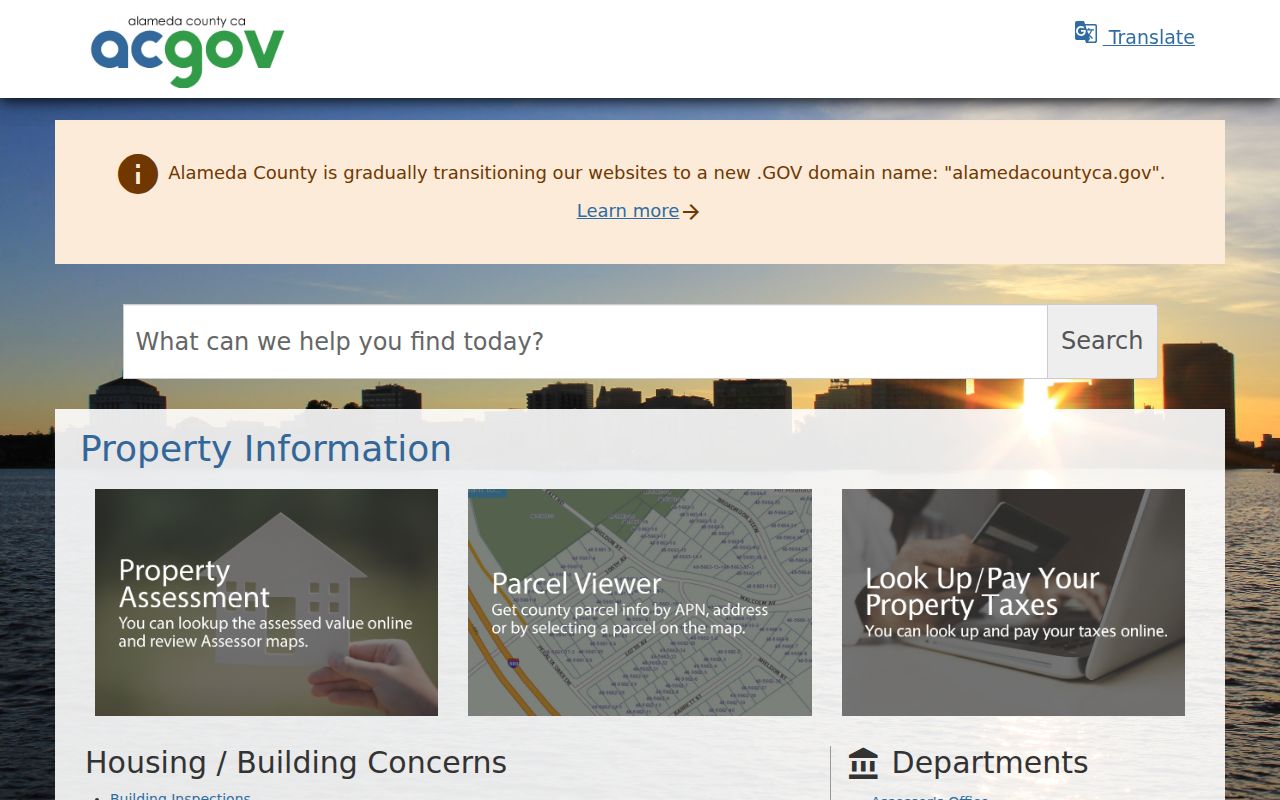
The county hub helps an Oakland owner move from a warning letter to official parcel and assessment sources before responding.
Note: Verify an unexpected deed notice, court demand, or unclaimed-property offer through the listed public office, not the sender's contact details.